
If you are choosing curtains for a bedroom, nursery or media room, you may have come across two similar terms: “blockout curtains” and “blackout curtains”.
So, what is the difference?
In Australia, blockout and blackout curtains usually describe the same general type of light-blocking curtain. Retailers and curtain manufacturers may use the terms differently, but there is no universally applied naming rule that guarantees one term will always block more light than the other.
The more important distinction is between:
- How much light the curtain fabric can block
- How much light enters around the installed curtain
A highly opaque fabric can significantly darken a room, but light may still enter above, below or around the sides of the curtain. That means fabric choice, curtain size, track position and installation method all affect the finished result.
This guide explains how blockout curtains work, why light gaps occur and how to choose the right level of light control for your Australian home.
Are Blockout and Blackout Curtains the Same?
In everyday Australian retail language, “blockout” and “blackout” are often used interchangeably.
Some suppliers use “blockout” for curtains that reduce most incoming light and reserve “blackout” for products designed to produce a darker room. Other suppliers use either term for the same type of coated or tightly woven curtain fabric.
Because the terminology is inconsistent, it is better to compare the product specifications instead of relying only on the product name.
When comparing curtains, check:
- The stated light-blocking performance
- Whether the rating refers to the fabric or the complete installation
- The type of fabric construction
- Curtain width and fullness
- Track or rod position
- Possible light gaps around the window
- Whether a separate lining is included
- Whether fabric samples are available
The key point is simple: the word “blackout” does not automatically guarantee that a finished room will be completely dark.
Fabric Blockout vs Whole-Room Blackout
One of the most common causes of confusion is the difference between fabric performance and room performance.
A curtain fabric may be described as 100% blockout because light does not pass directly through the tested material. However, the completed window covering may still allow light to enter around its edges.
This can happen even when the fabric itself performs exactly as intended.
Whole-room darkness depends on several factors:
- The distance between the curtain and the wall
- How far the curtain extends beyond each side of the window
- Whether the curtain reaches the floor
- Whether light can enter above the track
- The amount of curtain fullness
- The width and depth of the centre overlap
- The brightness and direction of the external light
For this reason, a fabric rating should not be interpreted as a guarantee that every room will become completely dark.
If maximum darkness is important—for example, in a shift worker’s bedroom or a home theatre—the entire curtain system needs to be considered.
How Do Blockout Curtain Fabrics Work?
Blockout fabrics reduce light transmission in several different ways. The most common constructions include coated fabrics, tightly woven fabrics and lined curtains.
Coated Blockout Fabrics
Coated blockout curtains have one or more layers applied to the reverse of the decorative fabric.
These layers help prevent light from travelling through the material. Depending on the design, the coating may also improve privacy and help reduce heat transfer through the window.
Coated curtains can be a practical option when strong light control is required without adding a separate detachable lining.
Before choosing a coated fabric, consider:
- The appearance of the front and reverse sides
- Care and cleaning instructions
- How flexible or structured the fabric feels
- Whether the coating suits the intended room
- The manufacturer’s stated light-blocking performance
High-Density Woven Fabrics
Some blockout curtains use a dense, multi-layered or tightly woven construction rather than a visibly coated backing.
The yarn density and internal structure reduce the amount of light passing through the fabric. These materials can provide a softer drape and a more textile-focused appearance.
However, performance varies between products. A dark-coloured dense fabric is not automatically a true blockout fabric, and a light-coloured curtain may still provide strong light control if its internal construction is designed correctly.
Curtains With a Separate Lining
A decorative curtain can also be combined with a separate blockout lining.
This approach may provide greater flexibility because the face fabric can be selected primarily for its colour, texture and design, while the lining handles much of the light control.
The total weight, heading style, track strength and cleaning requirements should all be considered when using a separate lining.
Coated vs High-Density Woven Blockout Curtains
Neither construction is automatically better for every home. The right choice depends on the required darkness, preferred appearance and intended room.
| Feature | Coated blockout fabric | High-density woven fabric |
|---|---|---|
| Light control | Can provide very strong light blocking | Depends on weave and internal construction |
| Appearance | Decorative face with a coated reverse | More consistent textile appearance |
| Drape | May feel more structured | Often has a softer fabric feel |
| Care | Coating-specific care may apply | Depends on fibre and fabric construction |
| Best suited to | Bedrooms and rooms requiring strong light control | Living spaces and bedrooms where texture is important |
Always assess an actual fabric sample where possible. Product photos cannot fully show fabric weight, texture, colour or how the material behaves under strong sunlight.
Understanding Lumarni’s Blockout Curtain Options
Lumarni currently organises its blockout curtains into three levels: Everyday Blockout, Premium Blockout and Total Blockout.
The percentages below refer to the stated performance of the fabric. The darkness achieved in the finished room can still be affected by measurement and installation.
Everyday Blockout Curtains
Lumarni’s Everyday Blockout Curtains are designed for daily household use and are listed with a 99.80% blockout level.
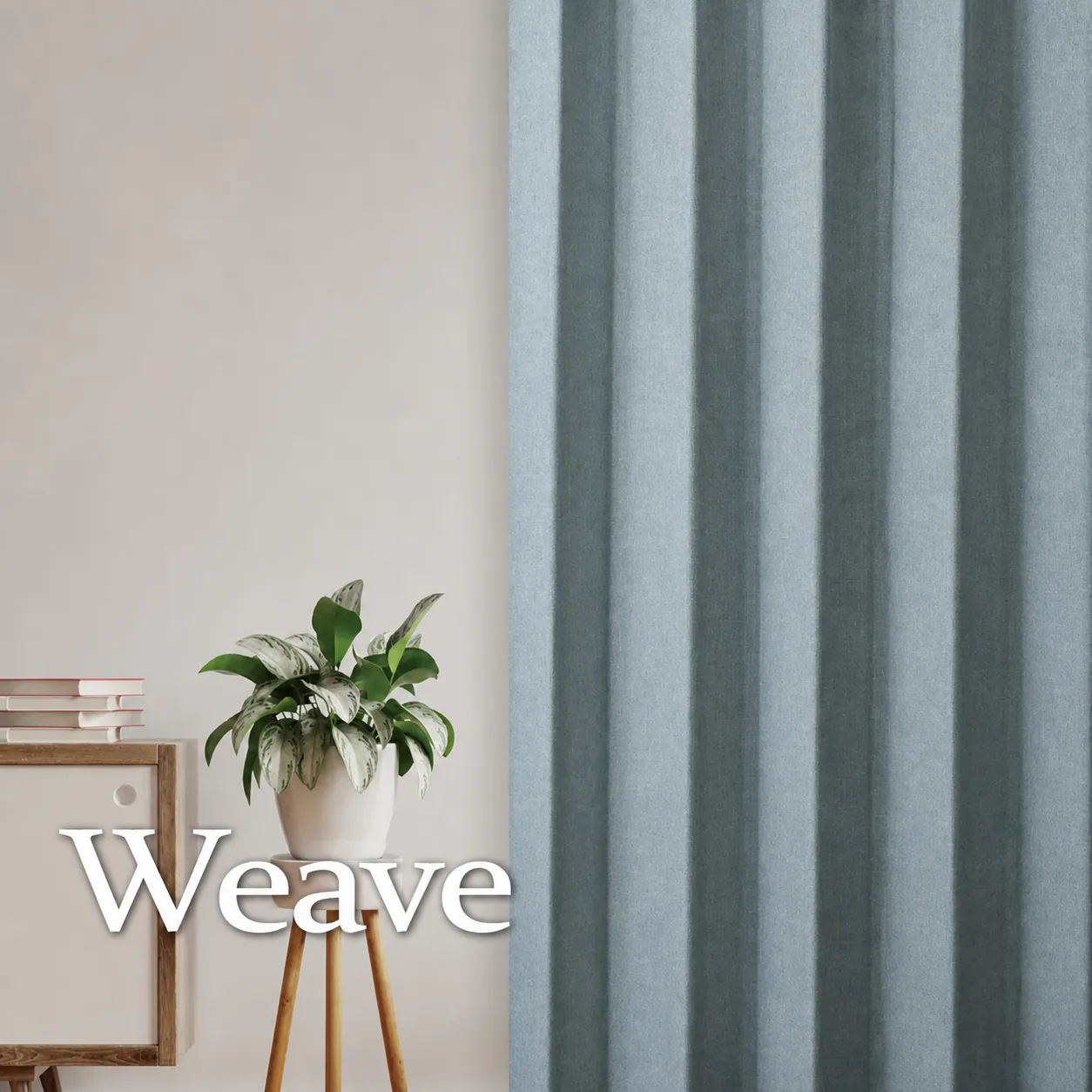
The current collection includes the Weave Everyday Blockout Curtain.
This level may suit:
- Living rooms
- Dining rooms
- Apartments
- Guest bedrooms
- Rooms where privacy and strong light reduction are needed
Premium Blockout Curtains
Lumarni’s Premium Blockout Curtains are listed with a 99.99% blockout level.
The current collection includes:
- Glacier Premium Blockout Curtain
- Risa Premium Blockout Curtain
- Ritz Premium Blockout Curtain
These curtains may suit customers who want a higher level of fabric light control combined with a premium made-to-order finish.
Total Blockout Curtains
Lumarni’s Total Blockout Curtains are listed with a 100% fabric blockout rating.
The current collection includes:
- Rod Total Blockout Curtain
- Arden Herringbone Total Blockout Curtain
These fabrics are intended for rooms where maximum light control through the curtain material is required.
Important: The 100% rating relates to light transmission through the tested fabric. The finished room may still have light entering around the curtain edges, depending on measurement and installation.
Why Do Blockout Curtains Still Let Light In?
If light appears around a blockout curtain, it does not necessarily mean that the fabric is faulty.
Light usually enters through one or more of the following areas.
Above the Curtain
A low-mounted track or rod can leave a bright gap between the curtain heading and the ceiling.
Installing the track closer to the ceiling may reduce this gap while also creating a taller, more streamlined appearance.
Around the Sides
Curtains that finish close to the window frame may not provide enough side coverage.
Extending the track beyond the window can help the fabric overlap the wall and reduce side light. The appropriate extension will depend on the window, wall space and curtain style.
Between the Curtain Panels
Where two curtain panels meet in the centre, a narrow opening may allow a visible line of light into the room.
Adequate fabric width, curtain fullness and centre overlap can help minimise this problem.
Below the Curtain
Curtains that finish above the floor may allow light to enter underneath.
Floor-length curtains generally provide better lower-edge coverage, although the correct length will depend on the selected style and practical requirements.
Around Obstacles
Skirting boards, handles, air-conditioning units and nearby furniture can prevent the curtain from sitting close to the wall.
These details should be considered during measuring rather than after the curtains have been produced.
Which Blockout Curtains Are Best for Each Room?
The highest fabric rating is not always necessary for every room. Choose the curtain according to how the space is used.
Main Bedroom
A strong blockout curtain can reduce early-morning light and provide privacy at night.
For a darker result, consider:
- Floor-length curtains
- A track positioned close to the ceiling
- Additional coverage beyond the window frame
- Sufficient curtain fullness
- Reduced gaps at the centre and sides
Nursery or Children’s Bedroom
Blockout curtains may help create a darker environment for daytime naps and early bedtimes.
Curtains should also be installed securely, with cords, chains and operating components kept away from children. Follow applicable product and installation safety requirements.
Shift Worker’s Bedroom
Shift workers often require a higher level of daytime darkness.
A total blockout fabric may be appropriate, but the installation should also be planned to reduce light above and beside the curtain. In some rooms, additional window treatments may be needed to manage persistent edge light.
Home Theatre or Media Room
For a media room, reducing glare can be as important as making the room darker.
Choose a high-performance blockout fabric and pay close attention to the track, curtain overlap and window coverage.
Living Room
A living room may not require maximum darkness throughout the day.
An Everyday or Premium Blockout curtain can provide privacy and light control, while a layered combination of sheer curtains and blockout curtains offers greater flexibility.
Sheers can soften daylight during the day, while the blockout layer can be closed when more privacy or light reduction is needed.
How to Choose the Right Blockout Level
Before ordering, work through these five steps.
1. Decide How Dark the Room Needs to Be
Do you want to reduce glare, improve privacy or create the darkest possible sleeping environment?
A living room and a shift worker’s bedroom usually have very different requirements.
2. Check What the Percentage Refers To
Find out whether the advertised percentage refers to laboratory-tested fabric performance or the complete installed product.
Do not assume that a 100% fabric rating guarantees a 100% dark room.
3. Order Fabric Samples
A sample allows you to inspect the colour, texture, thickness and reverse side of the material under your own lighting conditions.
Try holding the sample in front of a bright window during the day, but remember that a small handheld sample cannot demonstrate possible gaps around a finished curtain.
4. Measure for Proper Window Coverage
Accurate measurement is essential for both appearance and light control.
Consider:
- Track width
- Installation height
- Finished curtain length
- Side coverage
- Centre overlap
- Obstacles around the window
5. Compare Appearance as Well as Performance
Curtains are a major visual feature in a room. The fabric should suit your interior style as well as your functional requirements.
Compare colour, texture, drape and heading style before making the final decision.
Blockout vs Blackout Curtains: The Final Answer
In Australia, there is usually no reliable difference between the words “blockout” and “blackout”. Both terms are commonly used for curtains designed to prevent most or all light from passing through the fabric.
The best way to compare products is to look beyond the name.
Check the fabric rating, construction, curtain dimensions and installation method. Most importantly, remember that blocking light through the fabric is different from preventing light from entering around the curtain.
By choosing the right fabric and planning the complete installation, you can achieve better privacy, improved light control and a more comfortable room.
Compare Lumarni Blockout Curtains
Not sure which blockout level is right for your room?
Compare Lumarni’s Everyday, Premium and Total Blockout collections, or request fabric samples before making your decision.
Frequently Asked Questions
Do blackout curtains make a room completely dark?
Not always. The fabric may block incoming light, but light can still enter above, below or around the sides of the curtain.
Is blockout the same as blackout in Australia?
The terms are generally used interchangeably in Australia. Product specifications and installation details are more useful than the product name alone.
What does 100% blockout mean?
It normally refers to light transmission through the tested curtain fabric. It does not necessarily mean that the installed curtain will make the entire room completely dark.
Why is light coming through the sides of my curtains?
The track may not extend far enough beyond the window, or the curtain may sit too far away from the wall. Increasing side coverage can help reduce these gaps.
Are blockout curtains suitable for bedrooms?
Yes. They are commonly used in bedrooms because they provide privacy and reduce incoming light. The required blockout level will depend on the room and the sleeper’s preferences.
Should I choose coated or woven blockout curtains?
Choose according to the required light control, appearance, drape and care instructions. Requesting samples is the best way to compare the fabrics in your own home.
Can I combine sheer and blockout curtains?
Yes. Layering sheers with blockout curtains provides filtered daylight and daytime softness, with greater privacy and light control when the blockout layer is closed.